From Access to Agency.
The story behind Prometheus X, launched in January 2024, and why learning by doing, proximate builders, and human agency matter more than ever in the age of AI.
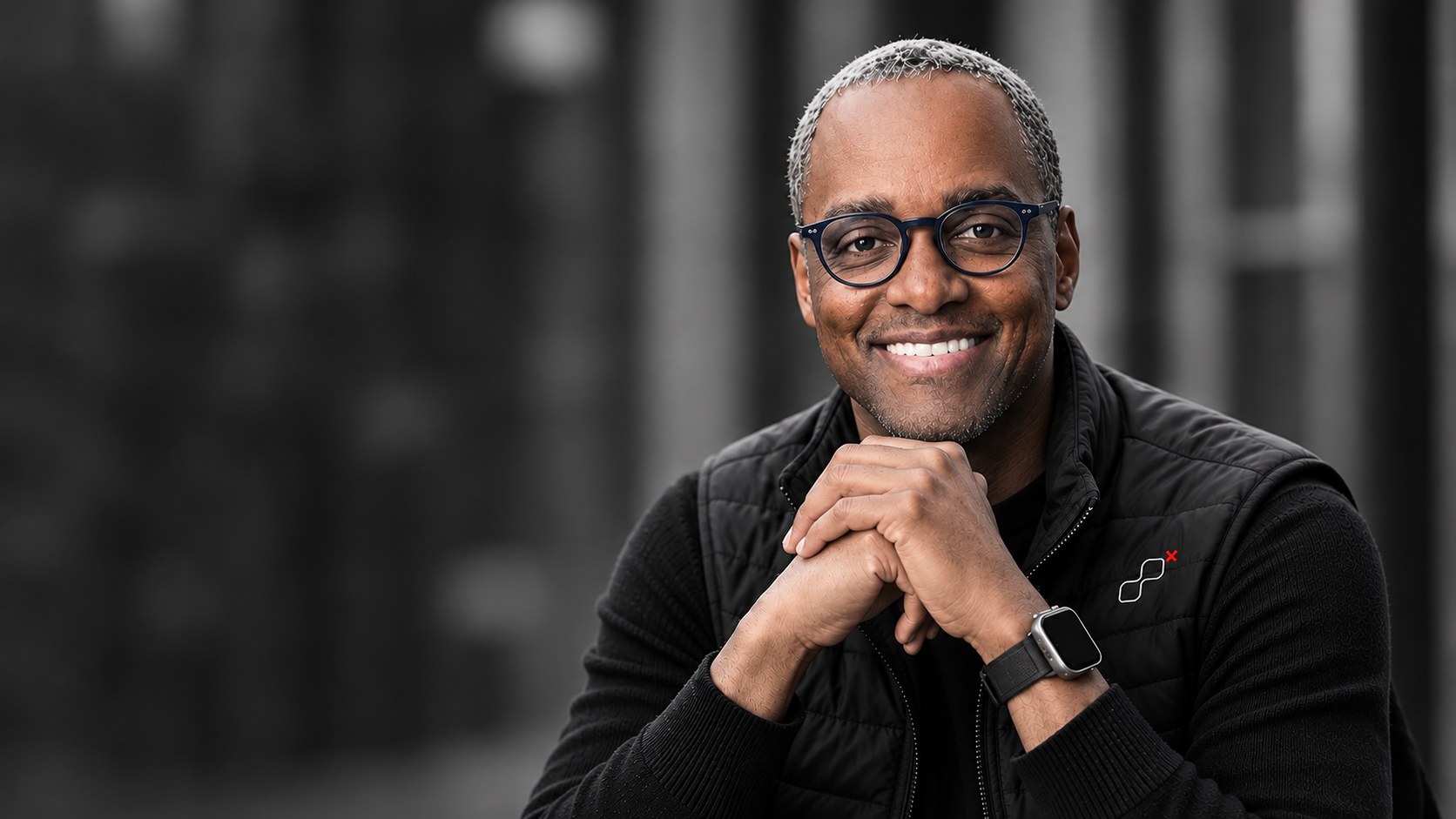
Artificial intelligence is changing what people can know, create, and accomplish. But as powerful tools become more accessible, a fundamental question remains: Who gets to shape what comes next? Founded in January 2024 following the spinout of the Virtual Center for Advanced Potential (VCAP), a program of Schmidt Futures, Prometheus X builds on an established effort to identify and enable overlooked talent. In this second edition of Prometheus X Prism, its founder reflects on that history, the importance of tinkering and agency, and why the people closest to consequential problems must help shape the solutions.
Why did you create Prometheus X?
I grew up in Kenya surrounded by people whose potential was every bit as real as mine, but who never encountered the opportunities that made a difference in my own life. That experience shaped a conviction that has guided my work ever since: talent is broadly distributed, but opportunity is not.
At Global Kids, I saw how young people develop agency when institutions recognize their strengths and give them room to act. At NYU, working on research and technology interventions with women smallholder farmers in West and East Africa, I saw how access to useful information could strengthen their ability to make informed economic decisions and exercise greater agency over their livelihoods. Later, at Yale, I helped build partnerships that opened new pathways for African researchers and institutions.
At Schmidt Futures, I helped establish the Virtual Center for Advanced Potential (VCAP), an initiative focused on advancing the science of talent and developing new tools, methods, and strategies for identifying and unlocking exceptional potential at the frontiers of science and innovation. Working alongside leading researchers and practitioners, we explored how promising talent could be recognized earlier, developed more effectively, and supported through catalytic investments.
Prometheus X emerged from that work in January 2024, with foundational support from Eric and Wendy Schmidt. As AI began expanding what individuals could learn, create, and accomplish, I saw an opportunity to extend that work into a new technological era, connecting the science of talent with the transformative possibilities of AI.
The question that continues to animate our work is: How much human ingenuity do we miss simply because we keep looking in familiar places?
Our ambition is to build a new kind of infrastructure for human potential, enabling more people, from more places, to shape the technologies and scientific breakthroughs that will define our collective future.
Prometheus X launched in 2024. Why is its mission especially relevant today?
AI is making sophisticated capabilities available to people who might previously have needed a laboratory, a large team, or considerable financing. A young researcher can now explore unfamiliar literature and attempt a prototype much sooner. That is exciting. It does not mean opportunity will distribute itself fairly.
My work as Managing Director of the Sports AI Innovation Center at Columbia Engineering has brought me closer to applied research on human performance, athlete health, and the ways AI might help address practical problems. It has also reinforced the value of looking beyond the more frenzied debates about AI to ask what these tools actually make possible, where their limitations become apparent, and what responsible use requires.
The old digital divide remains. Connectivity, reliable power, and access to devices still matter. The emerging AI divide goes further. Someone may have access to a model yet lack the time, technical support, computing resources, or institutional authority to build something meaningful with it. I worry that the people already equipped to experiment will capture a disproportionate share of the benefits. The mission we began in 2024 feels more urgent because the possibilities are growing faster than the pathways into them.
AI also has a physical footprint. Data centers consume significant electricity and, depending on how they are cooled and where they operate, can place demands on local water supplies. These pressures are not abstract for communities living near new infrastructure. They deserve a meaningful voice in decisions that affect their resources and livelihoods. If AI is to be genuinely beneficial, we must account for who bears its costs as well as who shares in its gains.
What capabilities will matter more as AI becomes increasingly capable?
I think judgment will become particularly important. A system may give you a persuasive answer, but it cannot relieve you of the responsibility to decide whether that answer makes sense in context. Curiosity and imagination matter because someone still has to notice which questions are worth asking. There is also the knowledge we acquire through experience. You can read a detailed account of how a rural clinic functions and still fail to understand why an apparently sensible intervention falls apart there.
This is one reason I care about the humanities. Philosophy helps us examine what makes a life go well. History shows how technology becomes entangled with power, often in ways its inventors never foresaw. Literature can deepen our understanding of another person's experience. These disciplines belong at the center of conversations about AI. Technical skill tells us something about what can be built; humanistic inquiry helps us judge whether it should be built.
Why do you place so much emphasis on tinkering and learning by doing?
My understanding of learning by doing began with young people, long before AI entered the conversation. At Global Kids, we approached youth development from their strengths rather than presumed deficits. A student’s life did not begin at the school door: what was happening at home or in the neighborhood affected how they could participate in class. Meaningful support had to take the whole person seriously. We also wanted young people to experience themselves as capable civic actors, rooted in their own communities while connected to the wider world.
Global citizenship became real through projects and exchanges that connected young people with places such as Hiroshima and Nagasaki, Bahia and Rio, Croatia and Haiti. They were not simply learning facts about the world; they were finding a place for themselves within it. I saw how a young person’s sense of possibility could change through an experience that demanded curiosity and initiative.
Some of my deepest learning has come from trying to make something work before I fully understood how. You get stuck, discover what you have overlooked, and try again. That process changes your sense of what you are capable of.
John Dewey and David Kolb helped articulate why experience matters to learning. Albert Bandura's work on self-efficacy suggests why successful attempts at difficult tasks can build confidence. AI could widen access to those formative experiences by making experimentation less expensive. But we should not mistake a polished AI-generated result for mastery. I want people to have more opportunities to discover what they can do through their own efforts. That is how agency takes root.
What does agency mean in practice?
Amartya Sen's capabilities approach has been influential for me because it asks what people are actually free to do with the resources available to them. Two equally talented people might have access to the same AI tool and still face very different prospects. One has a mentor who opens a door. The other cannot afford to take a month to experiment.
Sometimes the most helpful intervention is a small grant at exactly the right moment. In another case, an introduction to a laboratory changes the direction of someone's work. That is the kind of practical freedom I mean by agency. Access gives you a possibility; experience and support help make it real.
Who are proximate builders, and what are Proximity Labs designed to do?
Someone who has spent years living with a problem often notices things a visiting expert would miss. A community health worker may understand why families avoid a particular service. A farmer knows which constraints actually shape the use of a new tool. That knowledge can disappear when solutions are designed at a distance.
A proximate builder combines technical ability with an understanding of the setting in which the work will be used. Proximity alone does not make someone an expert, and no one person speaks for an entire community. Our Proximity Labs are intended to create opportunities for people with different forms of expertise to develop and test solutions together. I want the people who live with the consequences to have real influence over the work.
How will AI change work, skills, and credentials?
The evidence so far suggests that AI will change particular tasks within occupations in different ways. Some experimental studies have found substantial productivity gains in writing and customer-support work, especially for certain less-experienced workers. We still have much to learn about how those results translate into durable skills and longer-term employment.
I would like employers to take demonstrated work more seriously. If a young builder can show me a functioning prototype, describe its limitations, and explain what they learned through testing, that tells me something important. Degrees and deep disciplinary training will continue to matter. I hope they become part of a wider set of signals rather than serving as the default route to recognition.
Does AI make education less important?
Education may become more important because AI forces us to ask what learning is actually for. A student can complete an assignment with assistance and come away without understanding the subject. We need learning environments in which people are expected to investigate problems, test their ideas, and reflect on what happens.
AI also raises unsettling questions about meaning. A machine can simulate a conversation or produce a convincing piece of writing. Jean Baudrillard's work on simulacra offers one way to think about the distance between representation and lived reality. It is a philosophical provocation, not an empirical forecast. For me the practical question is what happens to our sense of mastery and purpose if we become increasingly accustomed to the appearance of accomplishment without the experience of making something.
I do not believe every possible use of AI is worth pursuing. Some applications may make life better; others could prove extractive or wasteful. The capacity to build something should never settle the question of whether it is desirable. Prometheus X is ultimately concerned with human flourishing. AI matters to us because of what it might enable people to do.
What have Prometheus X Fellows taught you?
What strikes me is how differently ingenuity can express itself when people have the opportunity to act. Jordan Unokesan is exploring AI infrastructure that could help institutions become more accountable. His earlier research used data to uncover troubling patterns in public spending. Akorfa Dagadu brings the perspective of a chemical engineer to Ishara, which is developing better systems for resource recovery in informal recycling economies. Both are responding to problems they understand deeply.
David Antwi and his co-founders are building Ocura, a wearable vision assistant intended to expand independence for blind and visually impaired people. Andrew Ddembe's Mobiklinic work draws on the realities of last-mile healthcare, including the practical role of community health workers in improving access to vaccination. Dr. Nnaemeka Emmanuel Nnadi is pursuing bacteriophage research in Nigeria to address antimicrobial resistance, while building local scientific capacity. His work is a powerful reminder that frontier science need not originate in the institutions we most readily associate with it.
These examples make the case for catalytic support better than an abstract statement ever could. The important question is what a timely opportunity enables someone to attempt next. Often the immediate grant is modest, but the learning and relationships it unlocks can last far longer.
What do institutions misunderstand about identifying talent?
We have developed systems that are fairly good at recognizing people who have already received recognition. That is understandable, but it can become self-reinforcing. Robert Merton described the Matthew effect in science, where existing recognition helps attract further opportunity.
Working alongside researchers and practitioners at VCAP taught us to look more carefully at emerging potential. Our experience with fast grants also shaped the way I think about institutional risk. If someone needs a modest amount of money to test a serious idea, an elaborate approval process can become the obstacle itself. Prometheus X's catalytic bets grew from that insight. We still have to exercise judgment and account for how resources are used. The diligence should match the decision being made. Sometimes the real loss is that an unusually promising experiment never happens.
Why must underrepresented communities help build and shape AI, not merely consume it?
I worry about a future in which communities participate in AI primarily as consumers, data sources, or low-paid contributors. People may share knowledge that makes a system valuable without having much influence over what is built or how the benefits are distributed. We should recognize those dynamics and make room for different arrangements.
The AI divide is partly a divide in agency. Who can decide what problems merit research? Can local languages and knowledge influence how systems are evaluated? Are the people most affected able to question harmful uses? I want Prometheus X to help widen opportunities for technical creation and meaningful participation in those decisions. It should become normal for people who know a problem intimately to have a role in shaping the technologies meant to address it.
What would success look like for Prometheus X in ten years?
I hope some of the people we support go on to make discoveries that change their fields. Others may build institutions that serve communities for decades. I would be equally pleased to see former Fellows begin backing the next generation themselves.
I also hope we help larger institutions rethink how they recognize and support emerging talent. We will not change the distribution of opportunity on our own, but we can demonstrate approaches worth adopting. I was fortunate to be given a shot, and I carry a responsibility to create that possibility for others. I want a future in which more people can make consequential choices about the technologies that shape their lives.
Further Reading
John Dewey, Experience and Education (1938); David Kolb, Experiential Learning (1984); Albert Bandura, Self-Efficacy (1997); Amartya Sen, Development as Freedom (1999); Robert K. Merton, “The Matthew Effect in Science” (1968); David Autor, “Why Are There Still So Many Jobs?” (2015); Brynjolfsson, Li & Raymond, “Generative AI at Work”; Noy & Zhang, “Experimental Evidence on the Productivity Effects of Generative Artificial Intelligence” (2023); Lave & Wenger, Situated Learning (1991); Jean Baudrillard, Simulacra and Simulation (1981; English translation 1994); International Energy Agency, Key Questions on Energy and AI (2026); Lei, Lu, Shehabi & Masanet, “The Water Use of Data Center Workloads” (Resources, Conservation and Recycling, 2025).